
“Many go fishing all their lives without knowing that it is not fish they are after”. Henry David Thoreau
Got up and around by 8:00 on day 4. My plan was to keep this a low travel day, and I had plenty of spots within a mile or so from camp. I had been thinking about the hike out since the first day, and I was glad my legs were feeling better. The heat of mid-day was draining, and I didn’t want to be climbing out of the valley in the afternoon. That meant I would need to get started as early as possible, which meant I didn’t want to get overextended today.
I still hadn’t found Piute Creek, so I made that my first destination. That’s not to say, of course, that I wasn’t open to a few distractions along the way. I stopped at a couple still pools and caught a few trout on dry flies. I tried to take a video of myself fishing a small pool. 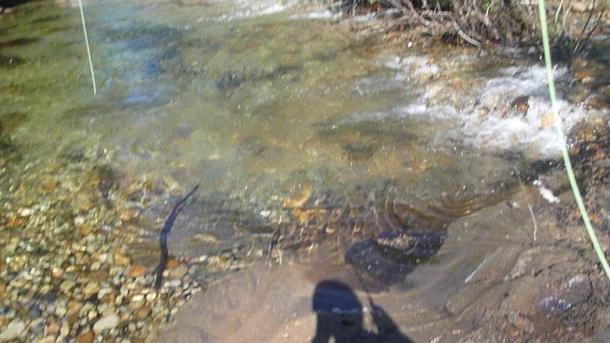 I did an OK job of juggling the camera while casting, but I didn’t get any strikes despite the excellent conditions. I’m convinced there is some subsonic waves put out by a video camera that spooks trout, because I couldn’t catch anything while that thing was running.
After a little rock hopping, I came to a fork in the stream. Looking at the landscape, I concluded this must be the mouth of Piute Creek. It was an extremely low flow, but the streambed was wide enough that I guessed that trout made it their home. 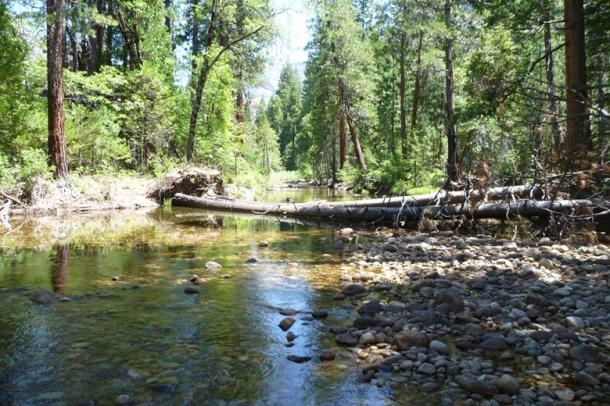 I carefully approached the first 100 yards and came up to a large, crystal clear pool. Sure enough, at least 10 trout were leisurely swimming around. The water was smooth as glass and the breeze was imperceptible. I ate my lunch in the shade while I planned my strategy. I wasn’t going to be able to wade; in fact the fly line hitting the water would have probably sent the entire pool scattering. I tied on a King of the Water dry and gently tossed it onto the water. The fish weren’t holding in a spot the way they would in a current, so I had to wait until they meandered to my section of the water.
 It was a test of patience as I watched a rainbow come into view. He took notice of the fly and started a gradual rise to the surface to get a better look. It was like an aircraft coming in for a landing, only in the opposite direction. I timed his approach and forced my arm to wait. Then, in a split second, a tiny switch flipped in his brain that told him this was something worth eating and he shifted from a slow, graceful ascent to a lightning fast strike and turn. I set the hook and he instantly regretted his decision, taking me for a couple loops around the pool before coming in for a landing.

If was fun, but I knew nothing else would be rising in that pool for at least another hour. I walked back out to the main fork of the river to plan my next move. I could go back to the bridge where I had such great fun yesterday, but somehow it didn’t appeal to me. “But why?” I wondered. If my goal is to catch fish, why not go where I know the fish are? Being in the perfect setting for introspection and deep thinking, I had an epiphany about fly fishing. It’s ostensibly about catching fish, but I wouldn’t get the same sense of satisfaction with a stick of dynamite and a dip net, although I would probably get more fish. And anyone who has ever spent 20 minutes trying to untie tangled tippet only to have their next cast break off in the tree behind them has, at least for a few seconds, wondered why they picked fly fishing over some other less frustrating hobby like golf. So why do we do it? It’s the challenge. It’s finding a remote location, some water that the great mass of fisherman have bypassed, overlooked, or not been brave enough to test. It’s reading the water and understanding where the fish are, how deep they are, what they are looking for, what they are afraid of, how fast the current is, where the sun is, where your shadow is, what fly to use, where to drop it, how the wind will affect it, how long to let it drift, when to mend the line, and a couple dozen other factors that come into play with each cast.
And you either enjoy being consumed with all these factors or you won’t like fly fishing. Maybe it’s the fact that it demands so much attention that forces us to forget all the other things that run through our minds: the bills that need to be paid, the projects around the house that need to be fixed, the work piling up on your desk, that argument you have been avoiding…. No room for those worries when you are focused on dropping a Pale Morning Dun under an overhang to a rising brown trout.
Some guys’ idea of fishing is a taking the dog out on the boat with a rod, bobber, and a six pack. They toss out a worm on a hook and sit back and relax. I can understand the appeal of that. Sometimes that kind of low-energy pastime is just what you need to unwind. But fly fishing is not the prescription for that kind of rest.
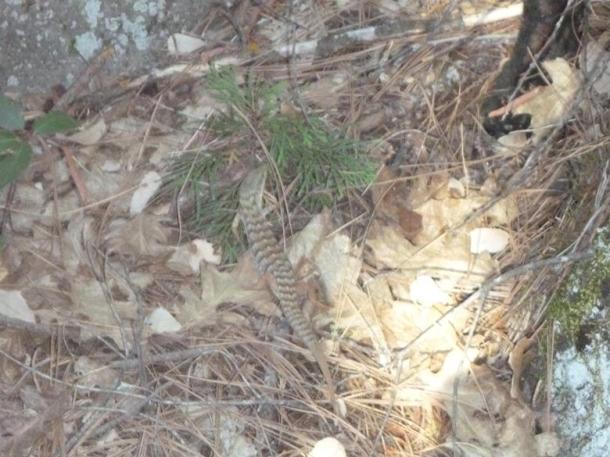
I went back to camp, where I found a couple visitors. A fat gray squirrel, which had apparently caught on to the value of scavenging campsites near the river, made a quick exit when he heard me approaching. The other was an alligator lizard who was much less eager to leave. He was about a foot long, and more colorful than this picture reveals. They are strange animals; their legs are tiny compared to the rest of them, and they look more like snakes then they move through the brush. I found one in the back yard when we lived in Southern California. They are harmless, but can startle you if you don’t see them right away.
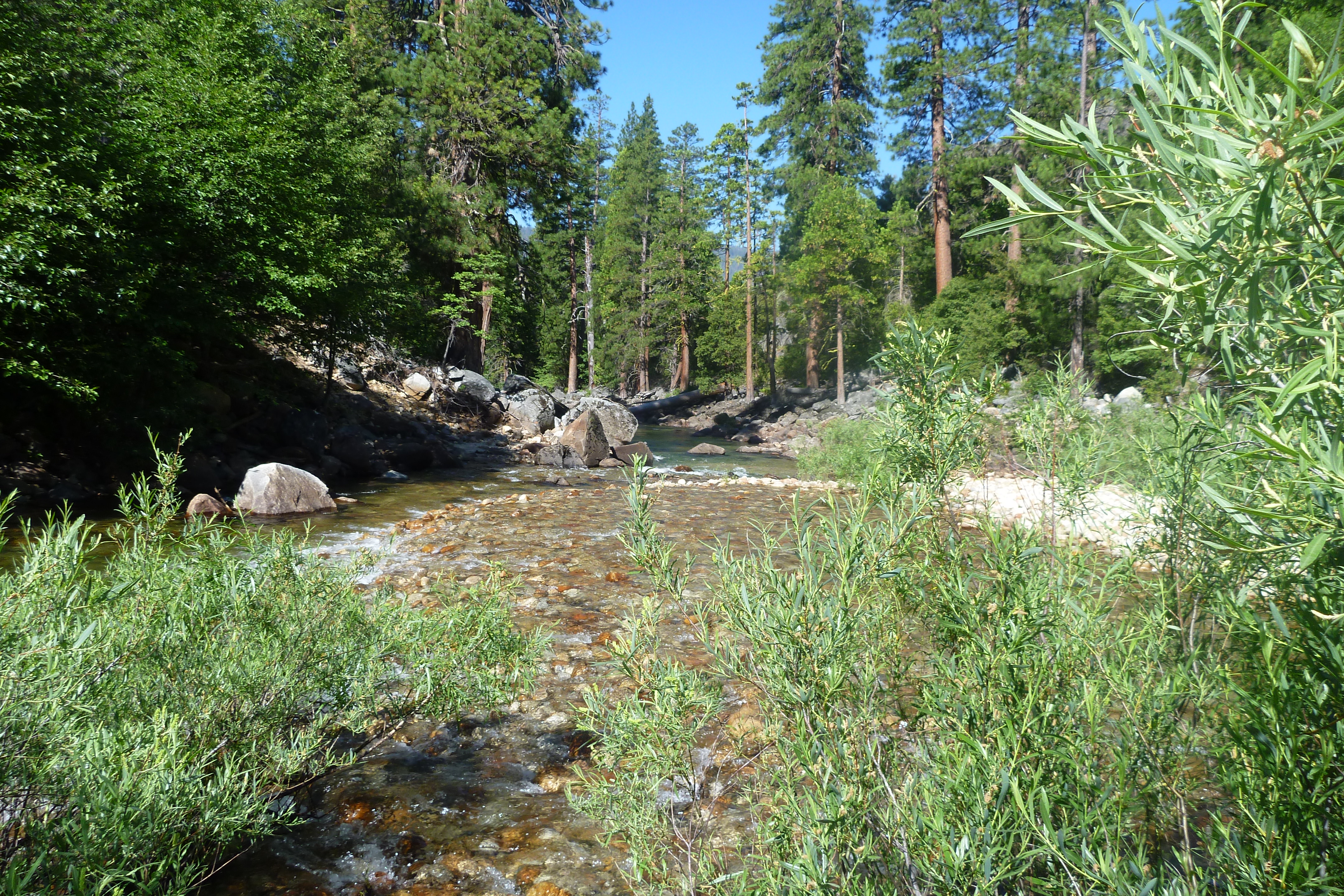
I made my last visit to the spa and hung up my wet clothes to dry before packing them for the hike out the next morning. I had an early dinner, and then went downstream a quarter mile to a place I discovered on my first hike to the valley. It was a long stretch of calm water that made a sharp right turn before falling off into a pool. I made a few casts on the trip down and caught a few rainbows. Then I tied on a streamer and cast into the rapids dumping into the pool. I had 2 or 3 violent strikes before landing one. It was exciting!
It was still light out, but I wanted to get back and pack up as much as possible so I could get an early start in the morning. I caught 17 fish on Day 4, which was a good day. I made a fire directly under the clothes line and hung all my wet clothing up to dry. I measured out the food I would need for the hike out and ate everything else. I wanted to start the day early, and with as many carbs as possible in my system.
I knew it would be a challenge; I hadn’t forgotten the toll it took on my legs on the way down, although climbing would strain a different set of muscles. I encouraged myself with the fact I would be carrying at least 10 fewer pounds of food on the way out. My goal was to leave by 8 at the latest, and be past the worst part of the climb before the heat of the day. I drank as much water as I could before bed and filtered 3 more liters for the morning.
I had taken down my rod and packed away my gear. It had been a good trip. I had conquered the illusive trout and survived the trek into the wilderness. But I knew this would be my last visit to Pate Valley. Time catches up with all of us. I was in decent shape, but my knees weren’t going to get any younger. Unless I hire a Sherpa to carry my gear, which are hard to find in these parts, I wouldn’t be making another 4,000 foot descent in a day hike. But it was OK. The Pate Valley had given me some good memories. The experiences would be with me forever. But I wasn’t about the number or size of the fish I had caught, it was about facing the challenge and testing myself. I suppose it’s a guy thing, and different guys have different things. But saying goodbye to Pate Valley did not mean I was giving up my ‘thing’. I still dream of another trip to Montana, Idaho, or maybe even Alaska. Bones can age and muscles get weak. But as long as you can dream, you’re never done living.

 fly-fishing-chronicles.com
As always, well written. Pictures are beautiful.