
“Next to prayer, fishing is the most personal relationship of man”. Herbert Hoover.
I woke feeling a little better on Friday. I could still feel the blisters on my feet, but they didn’t hurt enough to discourage me from the prospect of hiking a couple miles up the river. I ate some breakfast mix, packed a lunch, and left camp by 9:00 am. This would be my high travel day. I wanted to fish as far upstream as I could and still get back to camp for dinner. I knew of a footbridge about 2 miles away, but I wanted to break some new ground. There was also a fork where the Piute Creek met the Tuolumne River that I had not been able to locate on my previous trips. It would be easy to find if I waded the river, but the terrain doesn’t always allow. The trail generally follows the river, but sometimes wanders inland and up according to the geography, blocking the view of the water. The confluence of two or more streams often creates conditions favorable for trout to congregate, so I wanted to explore it for myself.
But along the way, I wanted to check out a few spots. As I mentioned in a previous post, the flows vary seasonally on this stretch of the river and can leave some large land-locked ponds that are home to fish. Water still flows in and out through the rocks under the surface so the holes are not going to dry up. And they were big enough so the fish had plenty of room and food to be comfortable.  The still water of the pool created a different challenge than the river. The presentation of the fly had to be much more delicate, and my approach more stealthy. The fish had probably never seen a hook, but they still had all the instincts of wild trout which meant they would spook if they saw me throw a cast or if I hit the water too hard with the line. It also meant that one fish would probably all a person could catch in an hour, because all the splashing and chaos would make the others too wary to bite anything for a while. I kept my distance from the edge as I approached the pond and made sure my shadow didn’t fall over the water. I could see as many as 4 trout cruising the water, casually rising to the surface. The leader I was using had at least 4 knots in it, and it wasn’t flying very straight anymore. It was fine for the rapids of the river, but I would need a softer touch for this calm water. I clipped off the whole thing and tied on a new tapered 12 foot leader. The 12 footers seem to work better for me fon or dry flies. On a good day I can steer a drop a fly gently on the water without leaving a ripple, looking as natural as the real thing. My mojo was working, and I landed a Royal Wulff on the far side of the pond like a feather. The water was crystal clear, but I couldn’t quite see to the far side to determine if any fish were in the area so I had to wait for a strike. WHAM! A small rainbow hit it! I set the hook and began reeling him in. He was about 11 inches, and a spunky fighter. I quickly got him off the hook and released him. He darted back behind a big rock with a colorful story to tell his fellow trout about an alien abduction. Because he hit in the north end of the pool, I tried a few more casts on the south end. I was surprised to catch 2 more before they went quiet, both about the same size.

The day was still young, so I wanted to check out the riffle I had tried the day before. As I walked along the bank towards the spot, guess who I saw basking on the beach?
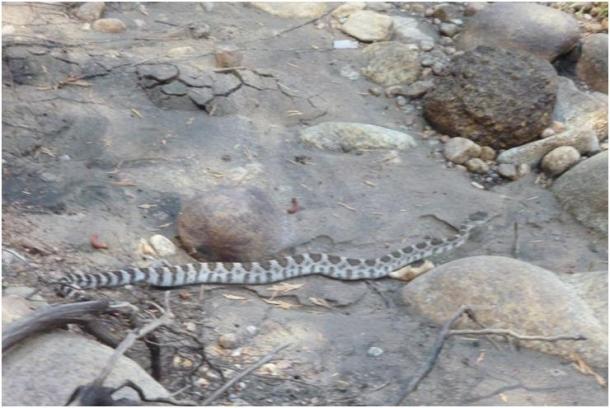
He was within 75 yards of the place I sat down next to a rattler the day before, the same length and markings. The Yosemite rangers warn of an abundance of rattlesnakes in the Pate Valley, but I still think it was the same guy.
I threw a few casts in this area but caught only one trout. I knew plenty more were there, but I wanted to save that area for Saturday since it was fairly close to camp. I pressed on up the trail to look for other spots. I walked on for another hour before I came to the bridge. Actually, two bridges are built there only a hundred yards apart. One crosses the main stream of the Tuolumne River, and the other crosses a nearly dry fork that is probably much more active during the spring thaw. A pack corral used to be near the far side of the bridges, but it doesn’t seem to have been used for years. The trail in this area had been shored up with concrete mix, probably to stop the erosion near the river and make it passable for pack animals.
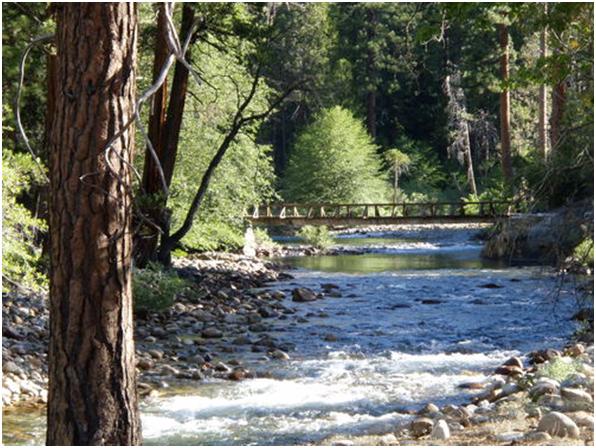
The water under the second bridge gets fairly deep, maybe 10-12 feet deep with a good current. It might be a good spot for a spinning rod, but fly fishing is probably only good in the evenings. Upstream from the bridge is more accommodating water. More on this later. The sound of the rushing river faded into the distance as the trail past the bridge wandered inland and entered a small meadow. The quiet was as profound as the scenery. I stopped for a few minutes just to soak in the surroundings. I even found some ripe, wild raspberries that were delicious. 
The trail in this area changed from rocky and dusty to lush and thick with vegetation. It was noon, and the temperature in the sun was past 90 degrees. But the shade of the trail was much cooler, and I sat down on a log to rest and eat lunch. 
After a half hour I pressed on through the jungle to get back out to the river. I had finished all my water, so I needed to filter some more. I was half a mile upstream from the bridge, and the topo map I studied said the terrain would be relatively level for another couple miles.  It was beautiful, but it didn’t look substantially different than the water I had already passed downstream. I was hot, so I decided this would be the far point of my hike and I would spend the rest of the afternoon fishing back downstream towards camp. I drank a liter of water and filled a bottle for my creel, and headed back to the bridge. Just upstream from the bridge was a shallow pool where I could see trout cruising. I made a stealthy approach on a rock face behind a tree, but as soon as I flipped a cast out they all scattered for cover. Incidents like this make it more satisfying to actually catch a trout, because we are reminded of just how wary they can be. (At least we fly fisherman like to tell ourselves this.) I decided to focus instead on the riffle that fed into the pool. It was 40 yards long and knee deep. I chose a path across the river that would be far enough upstream so that it wouldn’t spook the fish in the target area. Then I waded in slowly far enough so I could reach the riffle without getting caught in the trees.

It was possibly the best fly fishing spot I’ve ever encountered. From my first cast I was getting strikes. I caught 10 fish in about 30 minutes, and for each fish I caught I missed at least one strike. I’m not that bad at setting hooks, the action was so fast! Apparently dozens of fish were holding in the swift water, which was broken enough to conceal them from any overhead predators. The current was also fast; the drifts averaged only 4 seconds, which is very forgiving in terms of presentation. In stark contrast to the still waters of the pools where a delicate touch is required to drop the fly on the surface, a fast current tosses any surface item around like a cork. You don’t need a perfect cast, and even some line drag doesn’t necessarily make the trout reject the fly. It’s just fast and furious fun! The fish averaged 10-12 inches, a few smaller a few bigger. Nothing record breaking, but still fun to catch. Most were rainbows but I did catch a couple rainbow-brook hybrids, or “rainbrooks”. They had the white-tipped fins of a brook but the other markings of a rainbow. 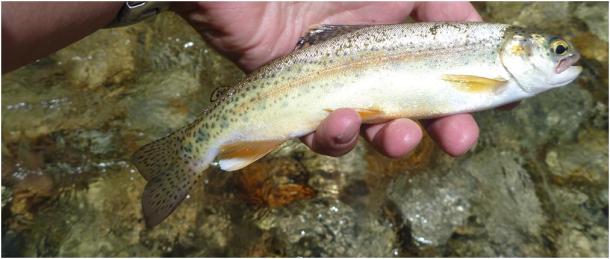
It was such a hotspot that I set up the video camera using the flexible gorillapod wrapped around a tree limb on the bank. I developed a whole new respect for Survivorman Les Stroud, who is already a living legend to me. He goes into remote areas of the world carrying nothing but camera equipment and a multitool, relying on his survival skills to find water, food and shelter for 7 days. The survival part is fascinating, but the skill required to singlehandedly film his adventures in a way that anyone can follow is truly remarkable. I fumbled with the camera for about 15 minutes to get it covering the area where I thought I would be standing, which wasn’t easy because I couldn’t get behind the screen to see what the lens was seeing. But I was so confident I could catch a fish that it was worth the struggle to get it on video. Or so I thought. The fish stopped biting while the camera was on. I did manage to get about 3 minutes of video, but it’s only interesting to me personally because I can relive the sights, sounds and atmosphere of the trip. I didn’t have a spare battery, so I shut off the camera so I would still be able to take pictures for the rest of the trip. I caught a few more fish, but then they quieted down. But it was a great hour of fly fishing!
The water was cool, but the sun was hot. I wanted to find some similar water conditions that I could fish in the shade. A few hundred yards downstream offered the opportunity. The river was only about 20 yards across at this point, and knee deep at most. But the water was fast and broken, and looked like a great place to hold trout. As I was getting set up a young couple walked up to the river from behind me. I suppose it’s a combination of concentration on the task at hand and the noise of the rushing water, but I didn’t hear them until they startled me. Turns out they were camping just above the bank and came down for a swim. A short walk downstream was a calm pool that went as deep as 5 feet, which was certainly inviting on a hot day. They got in the water only 30 yards downstream from me, but I wasn’t worried about them spooking the fish because of the conditions. In fact, I caught a nice 14 inch rainbow as they were wading in. I tried to snap some pictures as I was landing the fish, but it’s challenging to hold the rod, keep tension on the line, focus and operate the camera at the same time. Here’s the best I could do.

Everything was on dry flies, I hadn’t even tried using nymphs. Under the right conditions, the trout weren’t afraid to take food off the surface. I didn’t have much success in the deep pools, but in broken water they were hitting hard.
I caught a few more in that stretch and then made my way downstream to give the other campers some privacy. A long, shady stretch of water looked particularly alluring so I took my time wading along.

The afternoon had gone very well. I had ventured into new territory upstream, and found some hotspots. I had passed over several good spots that I wanted to save for tomorrow, but I still wanted to try out a large pool before getting back to camp. An enormous tree had fallen across the river several years ago and caused a large pool off the mainstream. It wasn’t landlocked, but the deep water and debris formed an ideal home for trout. I approached quietly from the trail and used the brush for cover. I spotted at least a dozen trout in the pool, including one very large guy who clearly dominated the territory. I was standing on a bank about 15 feet above the water, surrounded by trees and brush so I had no room for a backcast. The water was smooth as glass, and hitting it too hard would have the same effect as tossing a bowling ball in. I tied on a red humpy and fed out some line. Using an improvised roll cast, I managed to get the fly to drop gently about 20 feet out. It was a feeding frenzy! Fish raced from every nook and niche of the hole to see what had landed on the water. The first few rejected it, but in a swarm like that some fish is bound to take the fly just out of competition. Sure enough, a 9 inch rainbow grabbed it and I reeled him in. The big fish was at least twice his size, but trying to single him out with a cast would have been more of a challenge than I was ready to take on. Besides, now that the chaos had erupted there was little chance that I would get others to come up to the surface. But no matter; I had outsmarted them and I was satisfied. Time to head back to camp before the sun got too low.
On the trail back, I noticed the remains of a fencepost and a gate that some cowboy had once constructed. Yosemite became the first national park in the US in 1864, when Lincoln was president. The Wilderness act was passed 100 years later. I don’t know exactly when grazing was prohibited in the Pate Valley, but I have to think this gate was built before I was born.

I would have been a miserable job driving cattle 4000 feet up the side of the mountain to get them to market, but I suppose it must have happened. Still, it gave me pause to think that the view the guy had when he built this gate was probably not any different than the one I was seeing 60, 70 or 80 years later. But that was the goal of the wilderness act, to preserve the land for future generations. I’m glad guys like John Muir, Bob Marshall and Teddy Roosevelt had the foresight they did.
I got back to camp and went out to the river for washing. I made a small fire and had dinner. My legs held up pretty well, but I was tired. I caught 16 trout, and probably missed more strikes than that. But it was a good day. Gus and I were ready for bed. I laid staring at the stars for a while, thinking about how blessed I was to be enjoying this place. I had many good memories of this valley. But since the first night I knew that this would be my last trip, my last dance with White Wolf. As much as I loved this wilderness, the scenery, and the crystal clear water of the Tuolumne, the mileage was catching up with me. I knew tomorrow would be my last chance to fish the river and be part of the nature of the valley. I would miss it, but that wasn’t going to stop me from having a great day. I drifted off to sleep with good plans for the morning.

 fly-fishing-chronicles.com
Leave a comment