
I got up about 7:00 and took my last hot shower for the week. I was torn between trying to get some more rest and getting a good jump on the hike, and 7 am seemed like the right compromise. I packed up my stuff, which included loading a duffle bag with all the things I brought that I wasn’t going to take with me on the hike (shoes, cell phone, clothes I wore on the plane, etc.). This would stay in the trunk of the rental car until I hiked back out. I was one of the first in to the restaurant across the road, where I slammed down some French toast and orange juice. At about 7:45 I headed out of Kalispell. Just before the turn onto Hwy 2 I saw Snappy’s, a big sporting goods store. Having planned this trip for so long, I had thought about any little thing that might make it go bad and my wading shoes were at the top of the list. They pinched my toes the last couple times I wore them, and I didn’t want to get two days into my trip and have to stop fishing because my boots didn’t fit. I had looked at the fly shops the day before, but fly shops in Missoula are not the place find bargains. Snappy’s wasn’t going to open for another 15 minutes. I decided to wait.
Good thing, because I picked up a nice set of wading boots for about $50. They weren’t as high-end as the Sims boots I had, but they fit a lot better. Most boot makers are getting pressured into discontinuing felt soles due to the claim that they help spread New Zeeland Mud Snails. The Mud Snail plague is a problem, but I don’t believe that my wading shoes are a contributor. I also don’t have as much confidence that the new rubber soles, even with spikes, grip wet rocks as well as felt. So I was lucky to one of a vanishing breed- the felt-soled wading shoe.
Now I was ready to hit the trail. It was about a twenty minute drive from Kalispell to Hungry Horse, which was the last vestige of civilization before heading down the reservoir road to the trail head. Hungry Horse is little more than a wide spot in the road with a gas station and a souvenir shop with huckleberry jam, both of which close at 5:00 pm. I’m not sure anyone actually lives in Hungry Horse, which may explain why the horses go hungry.
Hungry Horse Reservoir is about 50 miles long and a few hundred yards across. Dirt roads follow both sides of it down to the Spotted Bear Ranger Station and a single bridge that crosses the river. I had called the Ranger Station in advance and learned that the east side was closed for road work, and I would have to take the west side road. It’s an hour-plus drive with no services, no cell phone service, and no buildings but some fantastic scenery. I crossed several creeks that would have been great for brook trout in Northern Michigan but were barren in Montana. Like California, Montana had a very heavy snow pack last winter and creeks were still swollen from the runoff. By fall, only the largest creeks would still have water. The road varied in elevation from twenty to a hundred feet above the reservoir, offering some spectacular views of the long stretch of blue water. I wanted to stop and admire it but I was burning daylight and knew I would have many more opportunities over the next week.
My entry point was the Meadow Creek Trailhead, which was really just a parking lot where Forest Service Trail #80 begins. There were about a dozen cars and a few horse trailers in the lot. They did have ‘restroom facilities’, which is a euphemism for an outhouse with no running water and no trash can. It seemed like a waste to be paying for a rental car for a whole week when it would be parked in the lot for most of the time, but I couldn’t find another alternative. No public transportation goes within 60 miles of the trail head, and hitchhiking isn’t the kind of adventure I was looking for. The last time I in Montana I paid a kid $100 to drop me off at Holland Lake and another $100 to pick me up a week later. It was cheaper than renting a car. But this entry point was much farther away, so renting a car was the only way to get there. I parked near the trail head, chugged my red-bull and a liter of water, strapped on my pack and checked my watch. It was 10:55. I had weighed in my pack at 48 lbs. before I left home, plus 12 pounds of food and another two to three pounds of fuel I bought in Missoula. My water, water filter and Gus were in my creel which I carried over my left shoulder. I had added another couple pounds of fruit and energy bars in a waist pack. I kept my GPS around my neck along with my sun glasses, so I figured I was loaded down at about 64 lbs. when I left the trail head. A little more than I wanted, but I couldn’t think of what else I could leave behind.
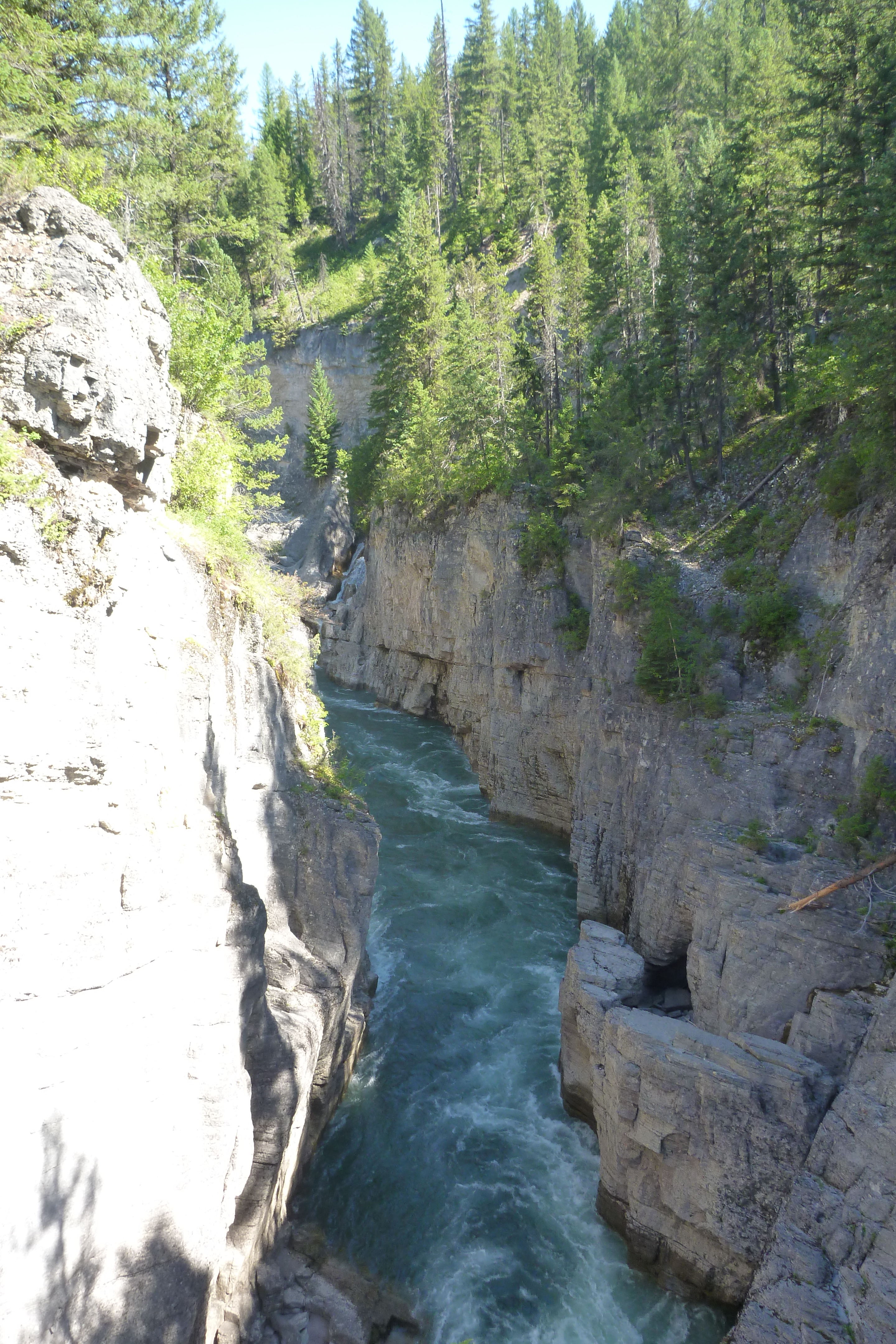
Just a hundred yards from the trail head was a bridge over the Meadow Creek Gorge. It’s a beautiful view of the raging river below, and perhaps the most treacherous stretch of the Flathead River. All rafters pull out a couple miles upstream to avoid this stretch, but it is quite photogenic. I snapped a couple shots and kept moving.
The trails in the National Forest are designed with pack animals in mind, so they take into account the geography of the area. In general, the Meadow Creek Trail (#80) follows the South Fork of the Flathead River upstream, but most of the trail averages two hundred feet above the river because it is the most uniform elevation. The big exceptions are the creek crossings, in which case you cannot avoid dropping down to the water level and climbing back up again. Those are the killers.
I wanted to get as far as Spotted Bear Cabin on the first day. From there I could set up a base camp and hike up and down the river without moving the tent every day. Packing up the tent has to be my least favorite part of camping. It just takes an hour to gather up everything, pack it, and strap it on. Then you have to lug it to the new site and unpack it again. It cuts into a lot of valuable fishing time, and I’m willing to put up with a lot of inconvenience to avoid it. Not that my tent qualifies as luxurious accommodation, but it’s still nice to have a place to ‘come back to’ at the end of a day rather than set it up every night. I had marked a spot ironically called Mid Creek as a halfway point. I had originally thought if I started at 8:00 am, I would aim to be at Mid Creek for lunch. I was starting three hours later, but it was still within my reach to get to Spotted Bear before sunset.
I charged out of the gate like a thoroughbred, making very good time on the trail. Maybe it was the Red Bull, maybe the carb loaded dinner and breakfast, or maybe just the excitement of starting a new adventure, but I was amazed at how good I felt. About an hour in I met a young kid in his 20s hiking the other direction, carrying nothing but his T-shirt. I joked that one of us was carrying too much or the other carrying too little. He laughed and we continued on our way without breaking stride. Everyone I met on the trail was very cordial. They were eager to greet me and talk about their experience in the forest. It was a refreshing change from life in an overcrowded California suburb where everyone puts up privacy fences to keep to themselves.
Mid Creek was about 4.5 miles from the trail head on the GPS, and probably a little farther when you take into account the switch backs and geography of the trail. I had budgeted 4 hours to get there, but I made it in just over 90 minutes. I was starting to think all that conditioning paid off and I was in better shape than I thought! I stopped long enough to eat lunch and refill my water. Most of the trail so far was under a canopy of shade, and the 80 degree heat hadn’t penetrated through to me. But I was still going through about a liter of water an hour, which was a healthy hydration pace.
Brimming with optimism, I strapped on the gear and pushed forward. Although the maps I had used were topographic (meaning they show elevation changes), I had not appreciated how many of the creeks were in the second half of the trail to Spotted Bear. Descending takes a toll as well as climbing because you have to “ride your brakes” down the grade to the creek. Then it’s like climbing stairs in a twenty story building (while carrying 60+ pounds) to get back to the trail level again. About three of those in row started to take their toll. I learned a valuable methodology later in the trip that I hadn’t mastered yet on that first day, which was to rest before I get winded. Recovery time is much shorter and you can stave off exhaustion, a condition in which your body refuses to reenergize because it thinks you are just going to abuse it further. Having not understood this valuable rule of endurance hiking (or perhaps simply aging), I pressed in to the hike, calling up all the testosterone reserves I had. No wilderness trail was going to beat me, I am a conqueror!
But the forest had started heating up from sun, and I started dehydrating more frequently. I also couldn’t recall that energy I had at the start of the trip and found myself getting winded every 30-40 minutes. I stopped frequently to catch my breath, take in some carbs, and drink water. I was resting along a hillside when two horse riders came up the trail towards me. Although I wasn’t sitting on the trail, I was only a few feet off of it because there was no shoulder to use. I had shed my pack and put it a few feet further up the trailside. But the horses stopped dead in their tracks. The riders tried to coax them ahead, but they wouldn’t move. There just wasn’t enough room for them to pass me comfortably so they weren’t going to risk it. I looked up the trail, but it was at least another 100 yards before I could get off to the side and I just didn’t have the energy to put on my pack and haul it uphill. I asked the riders if I could come towards them and pass. They agreed, but the horses didn’t get to vote. I grabbed my pack in my left hand and slowly walked towards the riders. There was literally only 6 inches of room on the left of the trail, then a seventy degree slope that fell about a hundred feet. I grabbed on to a tree and held myself out as far as I could off the trail. 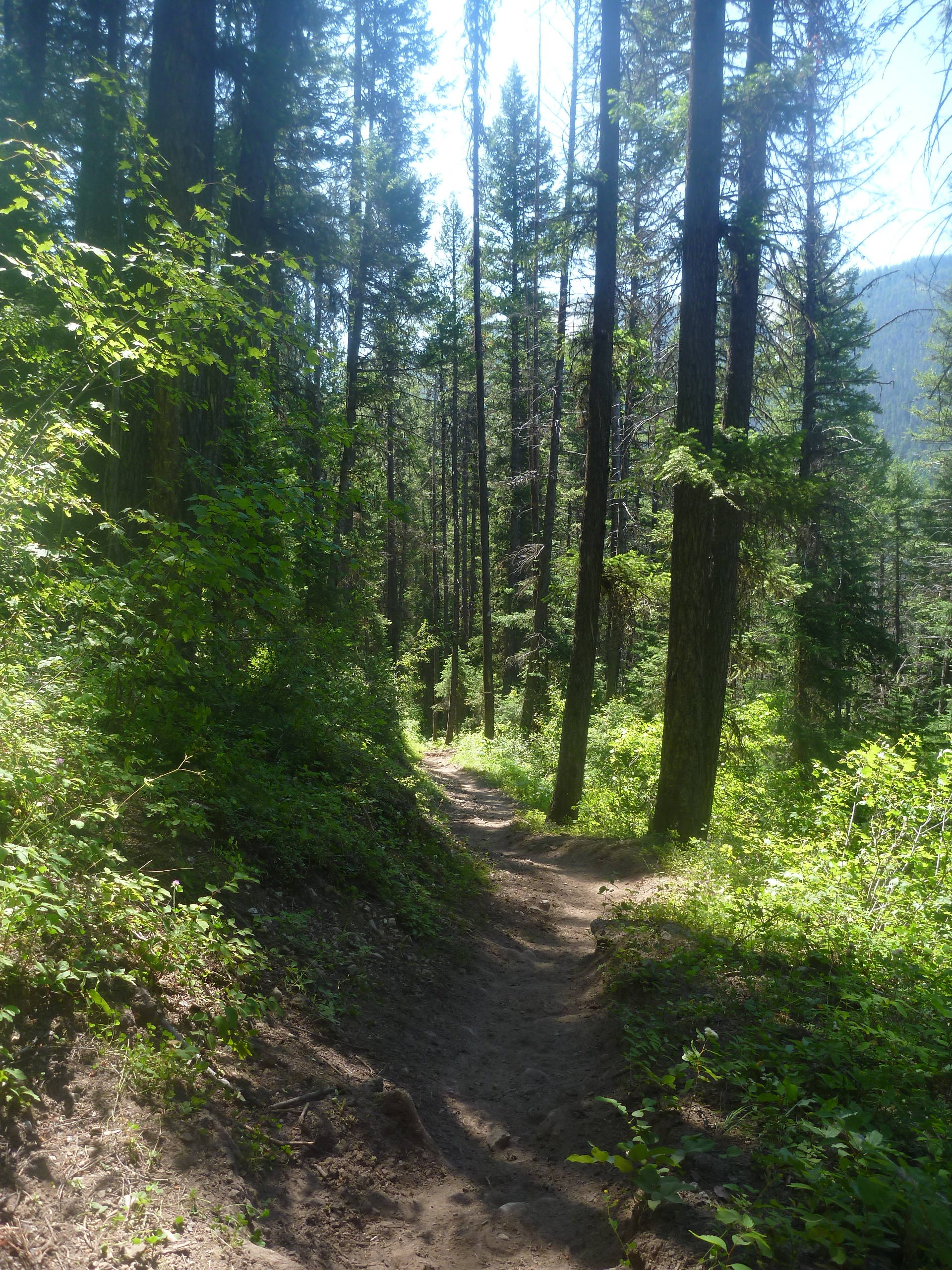 The riders, realizing this was as good as it was going to get, managed to convince the horses to pass along the trail and continue up hill. I went back to sit down and finish recuperating. I didn’t realize it at the time, but I had left some deep scrapes on my arm where I was clutching the tree. Oh well, the price of roughing it!
After recovering, I psyched myself up and headed back up the hill. I was relieved to find that it leveled out just around the bend. I was just getting my rhythm when I saw a pack train coming my way. Fortunately there was a small area for me to step aside and let them have the trail. I would learn later that the correct protocol is to find a spot on the downhill side of the trail, if available, when allowing animals pass. In this case the only space was on the uphill side, so I wasn’t really breaking any rules. The train was led by an outfitter on a horse, followed by 5 mules and another ranch hand on a horse. The leader gave me a friendly greeting and thanked me for letting them pass without breaking stride. He then politely asked me to ‘talk to them as they pass by”. This is also part of the forest trail protocol; to let the animals know you are a friendly person and not some strange beast that might attack them. So, even though it might sound foolish in another environment, I felt perfectly normal addressing a string of mules with salutations like “Hi guys, nice to see you, working hard today, huh? You’ll get to rest soon. Looking good!”
An hour later I heard another pack train approaching from behind me. I looked for a good spot to pull off the trail and take a break. This pack leader was likewise very friendly and thanked me for giving them some room. I conversed again with the horses and mules as they passed by and everybody stayed calm. After a short rest I packed up and continued on, but only 15 minutes later I saw that the train had stopped ahead of me. Not wanting to make them nervous, I stopped about 60 yards back and waited. I couldn’t tell what the holdup was, but it seemed like it would take a while. I set down my pack and watched for a few minutes. I could hear some commotion ahead, but the animals didn’t seem too worried. After a few minutes, they started walking again so I picked up my pack and moved ahead. I stopped again when I heard a horse uphill to the left off the trail ahead of me. A cowboy emerged leading a horse out of the woods back onto the trail. He was also quick to greet me with a smile, and asked very politely if I could step back a ways because he needed to tie up his horse by himself for a minute and he needed a little space.
I gladly obliged, and learned that he was leading his own train of 6 horses with when he met up with the train that had just passed me. Since horses and mules don’t have a reverse gear in their transmission, at least not on a narrow forest trail, one of the parties needed to find a way off the trail to let the others pass. Looking at the terrain, I was amazed that he would even try to get horses up the steep hill and keep them there while the others passed by. He brought them down, one by one and reassembled his train. He also had two dogs with him, which were obviously very well acclimated to life around pack animals. I was a good 20 yards off the trail, on the downhill side (I was learning!) when they passed me by, thanking me again for my patience. The dogs stopped and gave me a long look but decided I was OK when they heard me talking to the horses. An unusual code of trust exists in the wilderness.
My breaks were coming longer and more frequent as my energy was running low. The heat was taking a toll; I was drenched head to toe with sweat. It was getting late in the afternoon, and I was still about three miles from the cabin. I had crossed three creeks so far and still had one to go. I stopped before the decent and sat down to get mentally ready for the challenge. As I was resting, a young kid in his 20’s came along the trail behind me, carrying nothing. As he got closer, he looked familiar.
“Didn’t I see you on the way in?” I asked suspiciously. “Yeah”, he replied. “I’m Howard. I’m staying at Spotted Bear cabin with a work crew. I walked up to the trail head and am going back; 11 miles each way”.
Anybody else on the trail probably wouldn’t have heard it, but I detected a tone in if voice that suggested “What the heck have you been doing all this time, old man?” I started at him in silence for a few seconds, and then grabbed Gus, chambered a round and shot him in the kneecap. As he writhed on the ground holding his leg I stood over him and shouted “LETS SEE HOW FAST YOU MOVE NOW, WISE GUY!!”
OK, maybe that last part was just in my imagination. Besides, if he was staying at the cabin I could always sneak in and smother him in his sleep when I got there. Instead, I asked him about the remaining trail to the cabin. He told me it wasn’t far, but the trail ahead veered off to the right to get to the cabin. The trail going straight headed inland about a mile and then went further south. I thanked him and watched as he moved ahead down the trail and out of sight. If I gathered myself for the home stretch I figured I could be there by 6:30, set up the tent, wash off in the river and make dinner before dark. After a few deep breaths, I pressed on.
I went down across the creek and lumbered my way back up the other side. I could see the ridge line follow the horizon for the next mile or more, and was relieved that is was level. After about twenty minutes, I saw a fork in the trail. One path went down towards the river and the other went southeast. This spot wasn’t marked on my GPS, but I showed the cabin less than one mile away. I probably wanted to believe this was the path to the cabin Howard had mentioned and subconsciously convinced myself it was. I headed down the right fork thinking I was almost done. But after about fifteen minutes, the trail led to the river and then disappeared. My GPS showed the cabin was 0.3 miles ahead, but I couldn’t see it and the geography wasn’t very friendly. But I wanted to believe it had to be close, so I started blazing my own trail through a section of downed trees that had burned out about ten years back. I hoped that after a hundred yards or so I would pick up a trail again that would take me to the cabin. I now understand those stories of people stranded in the desert who chase mirages for miles. The hope of relief can be a powerful but deceptive motivator! Those that sixty four pounds felt more like two hundred every time I had to step over a log and pick my next step. This is when that tidbit of information about exhaustion would have come in handy. I could only walk for ten minutes, then rest for ten. By seven o’clock I still hadn’t found the trail and decided to get out the map I had rolled up inside my fly rod case. I then realized that the trail actually went south past the cabin and then looped back to drop down to the river. I had taken the wrong fork. I figured the correct trail had to be due east of me, but it was at least eighty feet up a steep bank that there was no way I could have climbed. The only choice was to backtrack to the fork and go back up the right way. It was a crushing realization, but having to set up camp there and pack out the next day was even more demoralizing. I convinced myself that if I just sucked it up for another hour I would get to relax. I inched my way back up the trail to the fork and got back on the right path (sounds like a metaphor, no?). I knew I would have no more climbs remaining, but each step was a challenge. I found the real trail fork and took the well-worn path to the right. After a few minutes I could see the bridge down below. I was happy, but exhausted. I pressed on to the base of the bridge where I dropped my pack and collapsed. I knew from experience I would be miserable if I didn’t wash and eat, but sleep felt like the only thing I could do. I hadn’t paid attention to the time the sun set, so I didn’t know how much daylight I had left. I forced myself to get up and cross the bridge. I wasn’t staying in the cabin, but I wanted to camp within sight of it. I pitched my tent in a level spot near the river bank but still forty feet above it. I always look for a place that is unapproachable from at least one direction so I can reduce the potential for four-legged visitors.
I set up the tent and my bedding, and staggered down to the river to wash off. I learned from other fishing trips that one of the greatest transformative events in life is immersing myself in cold water after an exhaustive day outdoors. It never seems like a good idea, and my heart always warns me that it’s not looking forward to the jump start. But washing the sweat and grit off, along with lowering my body temperature is the most rejuvenating thing you can imagine. The river water was still cold from the run off. I didn’t measure it but I would estimate somewhere in the low sixty-degree range. After getting past a couple critical high-water marks on my body, I felt like a new person: Still a tired person- but different than the one who stumbled around the forest tripping over logs a few hours ago.
I’m pretty sure I ate something that night but I can’t remember what. Once I changed into my sleeping clothes and got in the tent I don’t think even a forest fire could have coaxed me back out. I left the rain cover off the tent so I could see the stars. I had made it. The tough part was over, now the real vacation would begin.

 fly-fishing-chronicles.com
Leave a comment